

Guru Purandara Dasa, who extracted music from the Vedas and brought it to us
Tuesday, January 26, 2016

Saturday, January 23, 2016
T M Krishna: John Nash of carnatic music?
The music
was stunning; but regrettably so were the eccentricities.
TMK’s
concert on January 14 for Kalaivizha 2016, at Kamarajar Memorial Hall,
Teynampet, provided ample grist for anybody who wanted to profile him either as
‘eccentric’ or ‘genius’.
 The music
was unexceptionably brilliant, completely out of the ordinary. The Begada
alapana and the padam, Yaarukkagilum
Bhayama, seemed to be the main fare, even though technically the crown
should be fitted onto the head of the Kalyani varnam, Vanajakshi, for the tani was attached to it. There was a Jayadeva’s
Gita Govinda, Priye Charusheele,
rendered in Mukhari, and between the opening piece, Thyagaraja Swami’s Sahana
composition Emmana and the Priye Charusheele, came an explosion of
multi-raga tanams, which TMK and violinist R K Sriramkumar took turns to lead
each other…well, even the most fastidious adherent of tradition would have to
admit, was bloody good! It was one of TMK’s finest concert. Ten days down the line,
the Begada continues to buzz around my ears.
The music
was unexceptionably brilliant, completely out of the ordinary. The Begada
alapana and the padam, Yaarukkagilum
Bhayama, seemed to be the main fare, even though technically the crown
should be fitted onto the head of the Kalyani varnam, Vanajakshi, for the tani was attached to it. There was a Jayadeva’s
Gita Govinda, Priye Charusheele,
rendered in Mukhari, and between the opening piece, Thyagaraja Swami’s Sahana
composition Emmana and the Priye Charusheele, came an explosion of
multi-raga tanams, which TMK and violinist R K Sriramkumar took turns to lead
each other…well, even the most fastidious adherent of tradition would have to
admit, was bloody good! It was one of TMK’s finest concert. Ten days down the line,
the Begada continues to buzz around my ears.
But the
concert also seemed to throw up disturbing questions. Why does the man, so
insanely talented, behave like a fruitcake?
For better
part of the concert, he sat half-turned towards left, facing violinist R K
Sriramkumar, who was seated next to him. RK was sitting next to TMK, facing the
audience, and so the singer was turned away from them. Nothing wrong there, but
it did create a sense of disconnect between the singer and the people who had
gathered to listen to him. On a few occasions, TMK fell into silence, pausing
for longish durations—during which periods there were nothing to listen to
except the violin’s bow running on the string and the mridangam’s gentle
tap-tap—his eyes closed, face expressionless, like a vague somnambulist. During
one of such schizophrenic pauses, he rubbed his palms over his face and eyes,
like a man stirring himself out of stupor. And, an hour-and-a-half into the
concert, he asked the organisers, sounding vague and distant, till what time he
was expected to sing. (It is to the credit of his fine music that someone in
the audience shouted, “till 11.30” – the time then was around 8.15 in the
evening.)
At one
point, when he had taken the singing to a crescendo, there was an instant
applause from the audience, but TMK, still eyes closed, grimaced, waved
vigorously with both hands and said, “kai
tatti keduthudadinga” (don’t upset it by clapping.)
TMK’s
chin-up nonchalance and disregard for tradition is fine if there is a purpose
behind it. When Ariyakudi Ramanuja Iyengar established the kutcheri format that
has since become the norm, it was to bring carnatic music in sync with the
times. But if you sing a Sahana piece very elaborately, neraval and swaras and
all (and oh, neraval at one point and swaras at another), and then after the
audience has had its full and has applauded heartily and is eagerly awaiting
the next treat, you pick up again Sahana for tanam? I mean, there seems no
purpose behind vandalising guidelines of tradition and in the absence of a
purpose it does appear that TMK is merely trying to act out his iconoclasm,
rather aggressively, so as to say ‘I shall do anything I please’.
It is not
so much the demolition of tradition that is disturbing—in fact, it is not disturbing
at all. It is the attitude. Why? Why, after picking up a varnam in the middle
of a concert, has to append kalpana swaras to chittaswaras? (The swaras were at
the point of the last chittaswaram sequence, pa ma ga ga ri ri sa ri ri.) Why does this accomplished artiste,
whose music can shock-and-awe and command respect, need any antics at all? Why
– and what – is he so desperate to reform? As the Americans say, if it ain’t
broke, don’t fix it—and there is nothing wrong with carnatic music today, so why
fix it? Why does this accomplished artiste, whose music can shock-and-awe and
command respect, need any antics at all?
Attention-seeking
behaviour and exaggerated sense of self-importance seem to have become defining
traits of TMK. One well-known instance is his agonizing over a belief that
carnatic music is Brahmin-oriented, even as there are outstanding examples of
non-Brahmin carnatic celebrities—MS, MLV, Palani Subbudu, Yesudas, Madurai Somu
and a whole lot of Nadaswara vidwans, including muslims Sheik Chinnamoulana
Sahib and his son Kasim—and when carnatic music is entirely open to anybody to
take up. But there are other instances too. Remember when there was a spat
between reviewer V Subramanian and Sowmya, TMK jumped in, uninvited, saying “I
agree with Sowmya”? Or, his fulminations at the holding of the Season festival,
using words such as “vulgar” and “insensitive”?
As far
self-importance, check-out his website, www.tmkrishna.com.
Here is an excerpt from it: “Krishna ’s pen is sharp, his words blunt. He
thinks upon and writes about issues affecting the human condition and about
matters musical.” I’m not sure if these are
his own words, or someone else’s. In any case, they exist in his official website.
The January 14, 2016 concert was sparsely attended. The hall
wasn’t even half full. I hope that it does indicate dwindling popularity. I
hope the fact that it was a Thursday and was a priced concert, explains the
thin attendance.
For, regardless of his oddities, his music is nothing short
of great.
||||||||||||||||||||||||||||||||||||||||||||||||||||||||||||||||||||||||||||||||||||||||||||||||||||||||||||||||||||||||||||||||||||
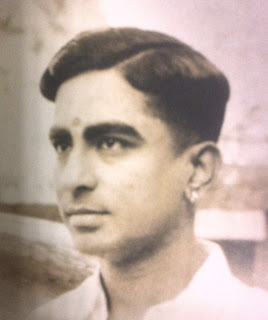
Hint for 'Guess who? - 1'
||||||||||||||||||||||||||||||||||||||||||||||||||||||||
||||||||||||||||||||||||||||||||||||||||||||||||||||||||||||||||||||||||||||||||||||||||||||||||||||||||||||||||||||||||||||||||||||
Hint for 'Guess who? - 1'

This picture should tell you who he is.
If you still can't guess, scroll one post below to know who.
||||||||||||||||||||||||||||||||||||||||||||||||||||||||
Sunday, January 10, 2016
G S Mani: A great artiste, unfairly overlooked for Sangita Kalanidhi award

I first
heard Mani-sir on August 15, 1983—it was at Music Academy
Thirty-three
years down the line, the vocalist’s voice had not lost even a tiny fraction of
its timbre. Also, it was one of the finest Bhairavi alapanas I had ever heard,
built-up at a leisurely pace, with long karvais on each note—an exemplary
style, and vastly different from what rules today, which is to take off into a
flurry of brikhas like a monkey touched on the backside by a hot-iron rod.
Mani-sir took a moment to explain that the raga had influence of many
nadaswaram Bhairavis he had heard during his formative years.

The concert
was such a lovely one. It offered the listener so much. There was an elaborate
vivadi—the 71st Melakarta, Kosalam (Koteeswara Iyer’s Kaa Mugha).
There was a rare raga—Padma Deepam, derived from the Hindustani rag Patdeep.
Padma Deepam takes the swaras – sa, ga, ma, pa, ni, sa and descent the same as
its mother raga, Gowri Manohari. Mani-sir sang a brilliant composition, his
own. Then there was Thyagaraja swami’s Vijayavasantham, a derivative of the 54th
Melakarta, Viswambari. Nee Chittamu Naa Bhagyamayya was another piece that
Mani-sir had sung on August 15, 1983. Then there was Ganavaridhi (Thyagaraja
Swami’s Dayachudageeti). For those who wanted some familiars, there was a
Kanada (own composition) and the good old Bhairavi. In between, there was a
grand Suruti, with an elaborate, full-fledged alapana, followed by his own
piece. And then, there were some scintillating thukkudas, including a
Chandrakauns (naalai varum endre—his own), at my request.


The concert
had something for every taste!
As I was
listening, I was wondering why Mani-sir was being overlooked for Sangita
Kalanidhi. His merits are obvious, but to just recount:
- He has been a performing
Carnatic musician for over 60 years
- He is well-versed in Hindustani
music too
- As is well known, contributed
hell of a lot to film music
- He has composed over 300 songs
in Sanskrit, Telugu and Tamil
Few have
served Music as much as Mani-sir. Yet year after year, he is overlooked for the
Sangita Kalanidhi award.
||||||||||||||||||||||||||||||||||||||||||||||||||||||||||||||||||||||||||||||||||||||||||||||||||

Yes !

Answer to 'Guess who? -1'
Yes !
Lalgudi Sir ||||||||||||||||||||||||||||||||||||||||||||||||||||||||||||||||||||||||||||||||||||||||||||||||
But I would
partly blame him too. He doesn’t sing enough kalpana swaras, and rarely sings
neraval—though he is capable of doing both exceedingly well. For some strange
reason he believes that singing swaras in elaboration is not necessary—but the
listeners (me included) expect that. While that is no reason not to recognise
his merits, it is a small and avoidable gap in his music.
Tuesday, January 5, 2016
Mozart Vs Thyagaraja Swami, in my book, Silence of the Cicadas
In my just-released novel, Silence of the Cicadas, I show (through one of my characters) why Mozart is nothing compared with our Saint Thyagaraja Swami. Reference to carnatic music is confined to just a few pages in the book, and this discussion figures in those pages. Here are the relevant extracts:


AM I RIGHT?
Sunday, January 3, 2016
The strange style of Lalgudi G J R Krishnan
Mr R
Thyagarajan, founder and (till recently) Chairman of the Shriram group of
companies, an ardent fan of carnatic music for over seven decades, is an
atheist. However, God for him is one person – Lalgudi Jayaraman.
Thyagarajan-sir proudly calls himself a ‘Lalgudi extremist’, and loves
Lalgudi’s music to such an extent as to aver that there is no need for anyone
to listen to anyone else’s carnatic music.
Not
surprising, therefore, that Mr Thyagarajan should have continued to love
Lalgudi G J R Krishnan’s music, which he sees as an extension of the elder
violin maestro’s. Thyagarajan-sir feels Krishnan’s style of alapana is, apart
from being “refreshingly different”, is also highly intellectual and
imaginative.
If GJR
Krishnan’s performance at the Music
Academy
Since I
haven’t heard Krishnan much, particularly in the recent years, I do not know if
the Todi is a sample of his style, but Mr Thyagarajan says it is. I doubt it,
because Krishnan played a Rasikapriya later in the concert, which was not as
much a chain-of-small-links as the Todi was. (A better contrast to the
Todi-style was provided by Krishnan’s sibling, Lalgudi Vijayalakshmi, who
played a superb Madhyamavati, building up the alapana, brick by brick, with
long phrases. It was a treat to listen to her.)
I wish
Krishnan changes his style. It needs no mention that he, perhaps owing to being
a Lalgudi scion, is exceptionally talented violinist. He can easily change his
style—all it calls for is his willingness to do so.
His
brilliant play was evident in all parts of the concert other than the Todi. The
composition that followed the Todi alapana, Syama Sastri’s Ninne Namminanu, as
well as a Kalyana Vasantham filler (Saint Thyagaraja’s Nadaloludai) were
numbingly beautiful. As I mentioned in my review of the concert for The Hindu (http://m.thehindu.com/features/friday-review/befitting-a-lalgudi-scion/article8050189.ece)
the violin almost spoke the words as he was playing Nadaloludai.
Saturday, January 2, 2016
Sangeetha gnanamu…..bhakti vina?
Mylapore
resident S Sivaramakrishnan , who has been
listening to carnatic music with a religious fervour for half a century, often
points to the difference in the colour of two Thodi’s he heard in the concert halls within days of each other.
The Koluvameragada that Seetha Narayanan was like meditating, it filled him
with peace. The other Koluvameragada, sung by a more accomplished, more famous,
next generation artiste “was much better in terms of technical brilliance” says
Sivaramakrishnan. “But it lacked that soothing aspect that Seetha Narayanan’s
had.”
Sivaramakrishnan’s
experience is but a sample of the reality today. As mentioned elsewhere in this
blog, the 2015 saw a soothing, meditative Kiravani by Malladi Brothers, which
was their ode for the Chennai flood victims. It was a no-frills,
no-wild-imagination, fancy-brikha kiravani, but it stood as one of the best
kiravanis ever head. On the other hand, a highly imaginative Mayamalavagowlai
by Abishek Raghuram failed to produce that effect.
Is the core
of carnatic music shifting from being devotional and meditative to more of
technical excellence and egregious display of talent? Is the renaissance of
‘Namasankeerthanam’ the market’s response to this shift?
Few
disagree, but views vary on whether it is necessary to hold on to ‘bhakti’ or just leave music to evolve
the way it society demands. True, the revered saint-composer, Thyagaraja,
stressed that music without bhakti
can never be ‘sanmargamu’, or the
‘good path’, but fewer and fewer are today in pursuit of any ‘path’, and look
to carnatic music more for entertainment.
Mylapore
resident, nanogenarian, Vittal Rao, says music is no more for sanmargamu (the noble path), but sammanamu (award).
Veena
artiste Balakrishnan Kannan, sets great store by ‘bhakti’. “Entertainment is the primary responsibility of a
musician, but still,” says Kannan, who begins his concerts with a veda- recital, “entertainment should not
be at the cost of the supreme meditative power of our music.”
For a
diametrically opposite view, we come to R Thyagarajan, founder of the Shriram
group, a big patron of carnatic music and a confirmed atheist. Deep devotion
may open up creativity in a composer, but linking bhakti with carnatic music, says Thyagarajan, is
“undesirable”. With advances in science,
man’s needs keep getting fulfilled and his ‘need’ for God declines. If music is
entwined with devotion, it will lose its appeal when ‘devotion’ declines in the
society, feels Thyagarajan. Besides, ‘bhakti’ weds you to words and lyrics,
consequence of which is preference for vocal music, to the detriment of the
instrumental. “Pure music shouldn’t have anything to do with words,” he says.
Between
Kannan and Thyagarajan lies the world of carnatic musicians, musicologists,
patrons and connoisseurs, each with a different preferred mix of meditative
appeal and intellectualism.
Vocalist Sikkil
Gurucharan represents the mid-point. “Our music is steadily staying
in-between,” he says. “I do sing a lot of emotionally-charged songs and intend
to get behind the mood of the lyrics,” he says. Yet, while on alapana and kalpana swaras, Gurucharan likens himself to “an explorer in a
forest of notes”.
It might
appear logical to assume that while older people bhakti-centric music while the
not-so-old love the more cerebral, flashy, splash-on-the-canvas kind of
creative music, but a quick sample shows that such profiling is not valid.
Samyukta
Ranganathan, a ‘junior’ vocalist (and daughter of singer Aruna Ranganathan), an
alumnus of Columbia
University
What does our
Sangita Kalanidhi Sanjay Subramanian say? Sanjay, never known to be a
bhakti-guy, excused himself from replying to questions relating to bhakti. (“Not my cup of tea,” he said.) However,
in an earlier, e-mail interaction with me he had observed that carnatic music
had always afforded space for both manodharma
(imaginative intellectualism) and meditation. “If manodharma (imaginative intellectualism) is the extreme left and
meditation is the extreme right, I can be described as slightly left of centre.”
Well, while
no musician will truly tell you, like Thyagarajan, that there is no need for
the keeping up the meditation quotient, any regular at concert halls knows that
not just Sanjay, but the entire world of carnatic music is shifting towards
‘left of centre’. Some believe that the space on the right vacated by carnatic
music is being filled by ‘naama sankeerthanam’, which (unlike musical discourse
or ‘harikatha’) seems to be on the rise.
“Namasankeerthanam has been
topping the charts in terms of audience response for some years now and it is a
really healthy trend,” says Sikkil Gurucharan. If artistes are finding a niche
market in namasankeerthanam concerts, is carnatic music spinning off a part of
it into a separate entity?
Long term rasikas shudder at the
thought. “You can still enjoy a very cerebral music,” says Sivarakamrishnan.
“But if you diminish the meditative aspect, you are extracting less value from
music.”
Don't sway, when you ought to stand upright
Atteeeeen-shun!!!!!
Boots stomp
the ground, click themselves into place. Then, the guys stand upright, till the
next order is screamed.
These
smart, upright uniformed chaps are a good metaphor for vivadi swaras—straight,
slim, no swaying.
Vivadi
ragas seem to be making a come back—why, have made a come back—to the concert
halls. Till about a couple of decades they had been banished into oblivion by
orthodoxy. Today, barring a few
old-fashioned, many artistes sing vivadis in detail, and that’s damn good for
carnatic music. Sanjay, Yesudas, B Kannan…are some vivadi buffs.
But in
singing or playing a vivadi, the artiste has to keep in mind the metaphor—the uniformed
officer standing in attention. Do a gamaka on a vivadi note, you lose the
flavour of the raga.
An example
of this was given by violinist Bombay Anand. Anand was accompanying veena
artiste, B Kannan, at Narada Gana Sabha. Kannan played a brilliant Kanakangi
alapana and it was Anand’s turn. Rather disconcertingly, the violinist kept
slipping into Todi.
Where did
the mistake lie? In two places.
First is
technical. Vivadi notes (as everybody knows) are like the upright officer in
attention. You can’t do a gamaka on them. No sway. Anand swayed on the ‘ga’ and
the result was Todi.
Second is
non-technical. I asked Kannan if he had told Anand the choice of the raga prior
to the concert. No. Kannan told him just before the concert began.
Kannan had
a nice practice session the previous evening. Anand didn’t. Had he been
informed, he too would have brushed up a bit and played neatly—after all, Anand
is a talented violinist.
And therein
lies a lesson. Lead artistes, if they intend to play the rare, should inform
the accompanyists beforehand.
Music Season 2015: What stayed in mind and what didn’t
Wow! What a
Season!
It began
bad with the rude, offensive, invidious and illogical ranting by carnatic
music’s Natakapriya, T M Krishna, but turned out to be damn good. TMK’s
sentiments may be noble, but his choice of words – such as, ‘vulgar’ and ‘insensitive’ -- to describe those who hold or attend concerts, is in very poor taste and reflects poorly on the man. But what else can one
expect from a man who praises himself to the high skies in his own website (“Krishna ’s pen is sharp, his words blunt”, he says)? Anyway,
when he was busy elsewhere doing whatever (such as endeavouring to
force-convert slum dwellers into carnatic connoisseurs) the 2015 Season went
very well.
My
participation was rather modest. I went to some 25 concerts, reported for The
Hindu on six of them, wrote an article on the paradigm shift from
bhakti-oriented to intellectual music, ate in several canteens….happy times.
But of all
the music across the 25-odd concerts I went to, the one that has remained stuck in my mind – it is
indelible, I guess – is Malladi Brothers’ Kiravani in the concert for Narada
Gana Sabha. And the one that I remember
for wrong reasons is Abishek Raghuram’s Mayamalavagowlai in his concert for
Brahma Gana Sabha.
These two
pieces of music represent opposite positions in carnatic music of today,
everything lies in between. But why are they the opposite positions?
The one that did - KeeraWOWni !!!!!!!!
Malladi
Sreeramprasad’s Kiravani, meant to be an ode to the Chennai flood victims, was
slow, leisurely, deep, emotive, meditative – like the slow but sure spread of
fragrance in a hall. It was joyful. It gave peace. It soothed frayed nerves,
relaxed the listener. But it was not particularly imaginative. The brothers did
not attempt to ride on their manodharma vehicle into unexplored territories of
the raga, but they sailed peacefully like a boat in a placid summer lake. Their
pallavi, ‘panchabhuta shantim dehi
parameswara karunaya’, sounded every bit like what it was meant to be—a
plea to the Lord for harmony with Nature.
I
juxtaposed the recording with many other Kiravanis, including the Hindustani
Kirwani, in order to try and find out what it else it resembled the most. The
closest was Sitarist Brigitte Menon’s Kirwani, and the next was Pandit
Shivkumar Sharma’s.
The one that didn’t – the ‘10,000-wala’ mayamalavagowlai
Abishek
Raghuram is a guy you can bet every single rupee you have on his becoming a
Sangita Kalanidhi some day. He is the man who will carry the torch from Sanjay
Subramanian for the dam-burst kind of manodharma music, a torch that Sanjay
himself seems to have picked up from Seshagopalan. (Whom did Sesha take it
from? GNB? Balamurali?) Abishek is the kind of carnatic musician who starts
off, and helplessly goes into auto-pilot. Something within him takes over, and
then, he is just an instrument…no, not even that…just a, say, loudspeaker….and
the music comes from some hidden well deep within. A brilliant artiste.
But….
But he is
too much of a vocal acrobat. Hear him sing gives you the same experience as
watching a bunch of monkeys on a tree, wildly swinging from branch to branch.
Too much of imagination, to the complete abrogation of aesthetics, sense of
proportion…makes Abishek, after some time, a bore.
All he
needs to do is to realise this.
Flashback
Many, many
years back, Seshagopalan, in a concert in Shastri Hall, Mylapore, sang the
lines ‘Sree Subramanyaya Namaste, manasija koti koti lavanyaya deena shranyaya’
some 25 times after nereval and
swaras were over. Just the lines, over and over again! It turned out to be
extremely tiring.
The next
day, T M A Raman, then a journalist with Financial Express and an ardent
carnatic fan – today he writes regularly for Carnatic Durbar – bumped into
Seshagopalan, and told him, “Sir, neythiki romba paduthitinga sir.”
“Aama, sir,
you are right,” agreed Sesha.
My fear is,
Abishek might turn out to be something of Sesha’s music of that evening. My
friend S Sivaramakrishnan and I will remember
Abishek’s Brahma Gana Sabha’s concert in December 2015 for wrong reasons.
Between the
Malladi Kiravani and Abishek’s Mayamalavagowlai seems to lie the sea of
carnatic music.
Truly, it
is like a food court. There are various dishes on offer, you take what you
want. There is nothing that can be called ‘wrong’. But it does seem that the
‘instant gratification’ variety is more on offer than the healthy.
Friday, January 1, 2016
Review of Sanjay Subramanian's concert for Indian Fine Arts, December 2015.

Sanjay
Subramanian is one of those artistes who lose themselves completely in their
singing. From the opening phrase, it was clear that the Bhairavi alapana would
be a long-drawn affair. The celebrated vocalist took time to anchor himself in
the raga, and then, entrapped in his own wild imagination, he raced around randomly
within Bhairavi, like a caged tiger. The vocalist’s eclectic learning was
evident from the multiple shades of musicians of yesteryears, notably Chembai
and D K Jayaraman. When he stood on an incredibly long karvai on the upper
shadjam, an amazed audience applauded heartily. The outcome was a Bhairavi
extremely rich in manodharma, though less-rich in aesthetics.

Not many
accompanying violinists could have played in step with such an imaginative
Bhairavi, but veteran Nagai Muralidharan seemed to have no difficulty in
matching Sanjay’s brilliance. When the violin’s raga sketch ended, as mridangist
Srimushnam Raja Rao was tapping the drum to check sruti alignment, and the
audience was waiting eagerly for Sanjay’s choice of the song, the singer
surprised everyone by beginning a tanam. He was aware of the effect he
produced, for he was all smiles as he sang ta-nam, setting it to Adi tala and
going through tala exercises, thisram, kantham and all that. Raja Rao seemed to
be only happy to be kept busy.
Then
followed a pallavi that began half a beat before the start of the tala cycle.
The lines ‘un darisanam kidaikkumo Nataraja’, made for a very enjoyable pallavi
and the only disappointment was Sanjay did not get into multi-raga swaras. Raja
Rao and Kanjira artiste K V Gopalakrishnan, played a sweet tani.
Earlier, the
opening bars of Sanjay’s another alapana showed it to be a vivadi, but singer quickly
ended speculation by announcing the name of the raga—Vanaspati. A vivadi is
always an aural treat and Sanjay produced an enchanting one. After the alapana,
replied in measure by Nagai Muralidharan, Sanjay picked up Vanadurge Vanaspati,
choosing the Harikesanallur Muthiah Bhagavathar’s composition over the more
famous Thyagaraja work, Pariyachakamaa. Vanadurge seems so rare that a google
search threw up only one other rendition of it, by violinist Nellai K
Viswanathan. The song has some chittaswaras and it was interesting to note
Sanjay singing the vivadi note, suddha gandhara, with a gamaka, which made it sound
like sadharana gandhara. That Sanjay did not tail the song with kalpana swaras
was a big disappointment—swaras help popularize rare ragas better.
Sanjay’s
other biggish offering was Dhandapani Desikar’s Dharmavati piece, Arulvai
Angayarkanniye, and a good part of the alapana was delivered in Sanjay’s
typical ‘mouthful-of-marbles’ style. Dikshithar’s Suruti Navagraha Kriti
Angarakam, Saint Thyagaraja’s Sahana composition, Evasudha and a javali in
Kannada language, mataada baaradeno, were the other elements of the thoroughly
enjoyable concert.
Sunday, December 30, 2012
Sumanesa Ranjini dazzles in Ustad-Bhagavathar's melting tones
Wah Ustaad !
Isn't this how we usually greet our Tamilian Bhajan singer O S Arun?
There was a time when some friends and I would let our eyes lightly flit over O S Arun's name in programme sheets, dismissing him as a kind of a Vittal-Vittal-Panduranga bhajan-wala, who is good at what he does, but not necessarily worthy of intellectual note. Such foolish arrogance on our part was lowered into its grave a few years ago, when we listened to the creamy imagination of pure carnatic notes even while singing bhajans with a strong North Indian fragrance.
When he sings the Marathi ‘Ha
Raghava!’ it is not some channa masala Bhoopali that splashes against our ears,
but the dazzling notes of the old-familiar, the Mohanam—and how! Strings and
strings of notes in newer and newer cocktails.
Or when he sings a tender
Malayamarutam (Karpaga Monohara) or Valaji (Koovi Azhaithal) in his own
loud-and-hard style, like the running of a herd of wild buffaloes on the face
of a large tabla. Dum-dhum-dhama-dhum-dhum.
Respect for Arun goes up.
Namaskaram, Ustaad !!
Several concerts—both bhajans and
carnatic kutcheri’s—later, the image of O S Arun is still that of a Hindustani
ghazal singer, who can also sing
carnatic. The don of the kurta and the Jeetandra hair-style (though parted on
the right side) underscores and highlights the Ustaad aspect of Arun.
We had to wait until the curtains
were up on his Narada Gana Sabha concert of December 2012 season. It was one bloody
good concert, so powerfully carnatic in style and the Karaharapriya
(Thyagaraja’s Idu Bhagyamu) that we were treated to was perhaps the best I have
heard in the last 30 years. We, the lovers of carnatic music, expect the
vocalist not to lightly flit over the notes, like a hovercraft, but dwell hard
on them, like a road-laying machine.
‘Azhutham’ we call it in
Tamil—the ‘pressing’. No Azhutham, no carnatic, and it is any slip-up on this
singular aspect that sometimes even geniuses like Jesudas lose their sway over
the audience.
But of Arun’s sooooperrrb
Karaharapriya, which can march with its chin up alongside with T M Krishna’s or
Sanjay’s, we shall say nothing further in this blog post. Suffice to say that
it was a great one.
The space belongs to the melancholy
rare that Arun melted the heart of his audience with.
Sumanesa Ranjini. Wow, what a raga!
It is (I later learnt) what you get
if you replace the lower madhyama in Suddha Dhanyasi to the upper madhyama.
Then, the raga could also be remembered as Amritavarshini with the lower ‘ga’.
However, when you hear it, you neither think of Suddha Dhanyasi nor
Amritavarshini. You see the resemblance more with Chandrakauns. Clearly, the
emphasis is on the lower ‘ga’, which gives the raga a melancholy touch, and the
sharp ring of the upper ‘ni’.
A quick ‘review of existing
literature’ shows that Sumanesa Ranjini has had to contend with a ‘minor raga’
tag. Arun changed it. It was quite an elaborate alapana that brought a
melancholy pall. After Mullaivasal Chandramouli’s commendable reply (the
violinist is playing extremely beautifully these days), Arun rendered a Tamil
composition, ‘Tamadamaen’—a composition of Dr Rukmini Ramani, the daughter of
Papanasanam Sivan (and not to be confused with the Sivan’s famous Todi piece
beginning with the same word.) It was a heart-rending composition on Goddess
Saraswathi. The only pity was that Arun did not sing swaras.
Sumanesa Ranjini appears to have
been used pretty well in Tamil film of those days. The Susheela Smash-hit
‘malai pozhudin mayakkatile naan’ of the film Bhagyalakshmi is in this raga. So
is the other hit, Oru Naal Iravu Pagal Pol Iravu, from the movie Kaviya
Talaivi.
Superb raga, this Sumanesa Ranjini.
I’d recommend rasikas prevail upon O S Arun at every opportunity to make him
sing this.
After this tear-jerker, the
vocalist did the smart thing by bringing in a thundering Atana alapana,
followed by Thyagaraja’s effervescent composition Chate Buddhimaanura, with
swaras on the pallavi line. The mood of the hall was by then well annealed to
receive the muscularly carnatic Karaharapriya.
Wah, Bhagavathar! What a concert !
Friday, February 17, 2012
A giant of an artiste and a lovable man: T V Gopalakrishnan
(Another (edited) version of this article appeard in The Hindu on February 17, 2012, and can be accessed at http://www.thehindu.com/arts/music/article2874905.ece )
“This,” said Tirupanithura Viswanatha Gopalakrishnan, pointing to a tall, ornate kuthuvilakku standing conspicuously in a corner, “was given to me in Bombay by Shanmukhananda Sabha,” and it was impossible to miss the metaphor. The object at which our attention was directed so remarkably resembled the man directing the attention in a metaphoric sense: tall in every meaning of the word, shining, swanky and pleasing to the eye. The Sabha had just given him a lifetime achievement award, instituted in the name of Sankaracharya. “It arrived here yesterday; and today I got the Padma.”
You can’t separate sentiment and a carnatic musician. The ‘Padma’ alluded to was the Padma Bhushan award, and TVG’s linking of the ‘blessing’ with the award was not just understandable—it was inevitable. As he waved me a seat, the parallelism between the lamp and the man became almost tangible. There stood the blessed lamp, a harbinger of national recognition, so flashy but so pure in its unlit virginity and TVG, flamboyance dripping from his garb and gait, yet affable and down-to-earth to a fault.
TVG—a Carnatic and Hindustani vocalist, mridangist, violinist, an everything-ist when it comes to music, a highly revered guru to a shipload of budding and blossomed musicians, both classical and filmy—stands tall among his peers as much for his musical prowess as for his legendary large-heartedness. A man at peace with himself, at ease with others.
TVG begins the conversation with a remark on how another journalist, who had managed to steal an earlier moment of his attention just a little while ago, asked him for the most memorable anecdotes from his life. “I am almost 80 years old; how could I possibly pick up any memorable events of my life. There are so many of them,” he said, pouring a bucket of cold water on my first question.
“Sir, I wanted to ask you the same question myself,” I said, fearing that in a spirit of candidness, TVG might be prompted to mouth the adage that ‘fools never differ’, but fortunately, he only smiled and obligingly took me on a tour down the memory lane, deep into the past, leapfrogging a full century and landing in 1896, the year in which his guru, the redoubtable Chembai Vaidyanatha Bhagavathar was born. Juicy anecdotes, plucked out of history like juicy cherries, fell all around in bunches.
I volunteer to prompt him with the mention of a concert. “Sir, do you remember the concert of Dindugal S P Natarajan, some time in 1985—with MSG on the violin and you on the mridangam?” I ask. At the mention of S P Natarajan TVG’s eyes light up. “Yes,” he says with some force. “You should speak about that.” That concert, he says, was one of the very best.
“I would rate Natarajan a notch higher than Mali,” he says. Poor Natarajan—he was not lucky. “After the concert that you mention (Bhairavi was the main piece), I arranged for him to play at Music Academy,” says TVG. “They gave him only 2.30 pm concert.”
“And he refused?”
“No. He agreed to play. But the day he was to play there, he fell off his scooter and fetched up at the concert badly bruised.” Consequently, the concert did not click.
Not many years after, Dindugal S P Natarajan died.
Anecdotes, memories burst forth. Kutcheries, ragas….politics.
But my job was more than chronicling TVG’s fond memories. The task on hand was to peer into the personality of the man who had so recently become a Padma Bhusan. He makes it easy for me, giving telling hints. “I have always been very flamboyant,” he says with disarming openness, in a strong Mallu accent, with an air of cheer and satisfaction but not a trace of conceit. He always had two cars, he said, while recalling his job of having to drop back his Hindustani guru Krishnanand home after each class. That was a part of the deal. Krishnanand first refused to teach TVG, putting it bluntly that he never taught carnatic musicians, who would only discontinue after the first six months. When TVG persisted, Krishnanand’s terms were “Rs 10 per class, six months’ fees paid in advance, and a drop-back home after each class.” This was back in 1969. When the word reached Chembai about his disciples Hindustani foray and the guru was first very disapproving, but later not only approved, but also predicted that TVG would become an accomplished Hindustani musician.
TVG’s ancestry of musicians gave him a genetic leg-up. His grandfather was a violinist (a fact that TVG would recall years later when challenged by Dwaram Venkatasamy Naidu’s son, Sathyanarayana, that he (TVG) couldn’t possibly become a violinist). His father was a musician in the Royal Court of Cochin and Chembai, therefore, knew their family quite well. In one of his visits to Thirupanithura, Chembai asked TVG, then a stripling of a boy, if he was up to playing the mridangam for him. An aghast father protested, a la King Dasharatha to Valmiki, at such a daunting task, but the young Gopalakrishnan was almost insouciantly at ease. After the concert, Chembai told TVG’s father, “dai Viswanatha, send your son along with me to Chennai. There aren’t many to play the mridangam and those who are in the field, are old.”
But the father would have none of it. TVG was the eldest of their nine children and he was keen that his son studied well, and got himself a government job. (That TVG did. He got his B.Com degree and then worked in the Accountant General’s office for a few years.) It was only after he completed his studies that Viswanatha Bhagavathar gave his consent for TVG to join Chembai in Chennai.
When TVG met Chembai in Chennai in 1951, the old man said: “You have come now, when I have lost my voice.” Chembai had lost his voice while singing in a concert on January 2, 1951 (accompanying Chowdaiah continued the concert as ‘solo’ violin, with C S Murugabhoopathy on the mridangam) and it was not until eight years later, Chembai would regain his voice, in the Guruvayur temple.
Those where tough days. In a field ridden with competition and politics, it was Dwaram Venkataswamy Naidu who lent him a helping hand. The first opportunity came when a scheduled mridangist could not come and someone suggested TVG’s name to Dwaram. Could T V Gopalakrishnan be auditioned? “No. Never do that” said Dwaram. “Never test an artiste. Ask him if he has heard me play. If he has, he can accompany me.”
TVG remembers Dwaram as a violinist who played with a “bell clear tone” whose musical extravaganza contrasted with his parsimony when it came to paying an accompanist. Though a man of no small means, Dwaram compulsively saved up for his later years, recalls TVG. But after the first concert that TVG played for him, Dwaram played the young mridangist a memorable compliment: “Mani, Palani and you”, he said, bracketing TVG with the other two all-time-great percussionist.
TVG recalls another memorable encomium, this from the legendary music critic, Subbudu. “You have a perfect hand, you will go a long way,” Subbudu told him very early on in his career. Of course, TVG’s guru, Chembai, had a lot of praise for his principal disciple. These compliments were the inspiration, “telling me that I was son the right track”, that helped TVG shaped his career.
Shifting to Madras was a right move, or else TVG might have ended up like his father, Viswanatha Bhagavathar. “My father never left our village,” recalls TVG. Viswanatha Bhagavathar always performed along with his father, violinist Gopalakrishna Bhagavathar, and after Gopalakrishna Bhagavathar died, Viswanatha Bhagavathar practically gave up singing. “Who will play fiddle?” he would say and I would tell him “let somebody play, what is your problem. Don’t you want to hear yourself sing?” but to no avail.
For a boy whose musical career began at an age of six when he played on the mridangam in the Cochin palace in the presence of Viceroy Linlithgow (in 1938), making a mark for himself was no big deal. Interestingly, TVG began his career on the twin tracks of vocal and mridangam—his first vocal concert was when he was about 14.
For six decades from the early 1950s, TVG has sung, played, conducted orchestras, taught, spoken music. Today, upon the receipt of Padma Bhusan, one can detect a slight, almost indiscernible rankle that the award took its time to come. But then, my guru also got the recognition very late, rationalizes TVG.
While any national recognition is something desirable, TVG perhaps cherishes his status as a guru more than anything else, for it is from that platform that he has served the art the most. His disciple list, including those who consult him from time to time, reads like a who’s who of carnatic music—interestingly, right across the spectrum. For instance, he has given his moulding touches to Yesudas and Unnikrishnan (to name just two) in vocal, Kadri Gopalnath (Sax), Varadarajan (violin), V Suresh (ghatam). Vidyabhooshana, the ex-pontiff of Subramanya Mutt, too is a disciple of TVG. “I helped him come out of sanyas,” says TVG, obviously pleased with having done so. Presently, a Caucasian walks in. “This is Sieg, he is learning mridangam from me,” says TVG. Siegmund Kutterer is a percussionist from Switzerland.
Inevitably, the conversation veers around the state of carnatic music. Why don’t we see vivadi’s taking a major space? Why is it that some ragas are the darling of musicians, some consigned to oblivion? Music, says TVG, is all about nostalgia. What evokes nostalgia is what people want, but he agrees that musicians must not lose the spirit of experimentation. He recalls Madurai Mani Iyer once telling him that in his (Mani Iyer’s) early days he was singing many rare vivadis. Musri Subramani Iyer advised him not to do that if he wanted to make a name for himself. “Still people come to my concert to listen to my Kaapali and Kaana Kan Kodi Vendum,” said Mani Iyer, a man whose name has been inextricably associated with Jyotiswaroopini, Umabharanam, Kannadagowlai and a host of other rare’s, to TVG.
TVG stresses on the need for keeping the purity of notes. Yes, gamakas are the hallmark of carnatic music, but they should be kept to the point. Needless swirls whereby one note encroaches upon its neighbour’s territory is abhorrent to TVG. He sings a clutch of ragas—Nattakurinji, Hindolam, Todi, Sudha Dhanyasi and Nasika Bhushani—in “the manner in which they should be sung” and in the way they are sometimes sung today, to demonstrate the difference. “Why do people still remember M D Ramanathan”, TVG poses a rhetoric, and loses himself into a MDR’ish Kedaram. To a lay listener, the limited-gamaka “pure note-way” is clearly more pleasing to the ear.
“The survival of carnatic music depends upon whether or not musicians keep the purity of notes,” he says, pointing out that if light music is so popular today, it is because the notes are in their pure forms.
Pure notes not only gives longevity to the art itself, but also to the singer. “Today, if (R K ) Srikantan (who is 86 years old) is still able to sing, it is because he sings pure notes,” says TVG with the force of an evangelist. “Why, take me, for instance. I am 80 years old and can still sing,” he says.
Bio sketch of TVG
Tirupanithurai Viswanatha Gopalakrishnan (born 11 June 1932 in Thripunithura, Kerala) is a Carnatic and Hindustani musician fromChennai.
Gopalakrishnan hails from a family of musicians, spanning over two centuries; his father was a court musician for the Cochin Royal Family. He is a vocalist, plays the violin and is also an exponent of the mridangam. Gopalakrishnan started playing the mridangam at the age of four and had his arangetram at the Cochin palace at the age of six. He is a disciple of Chembai Vaidyanatha Bhagavathar.
His students include , Ilayaraja, A.R.Rahman, Sivamani, Kadri Gopalnath, Vidyabhushana. He has also collaborated with drummer/composer Franklin Kiermyer on live performances.
Gopalakrishnan was given the Sangeet Natak Akademi Award in 1990. He has been awarded the Padma Bhushan by the Government of India in the year 2012.
“This,” said Tirupanithura Viswanatha Gopalakrishnan, pointing to a tall, ornate kuthuvilakku standing conspicuously in a corner, “was given to me in Bombay by Shanmukhananda Sabha,” and it was impossible to miss the metaphor. The object at which our attention was directed so remarkably resembled the man directing the attention in a metaphoric sense: tall in every meaning of the word, shining, swanky and pleasing to the eye. The Sabha had just given him a lifetime achievement award, instituted in the name of Sankaracharya. “It arrived here yesterday; and today I got the Padma.”
You can’t separate sentiment and a carnatic musician. The ‘Padma’ alluded to was the Padma Bhushan award, and TVG’s linking of the ‘blessing’ with the award was not just understandable—it was inevitable. As he waved me a seat, the parallelism between the lamp and the man became almost tangible. There stood the blessed lamp, a harbinger of national recognition, so flashy but so pure in its unlit virginity and TVG, flamboyance dripping from his garb and gait, yet affable and down-to-earth to a fault.
TVG—a Carnatic and Hindustani vocalist, mridangist, violinist, an everything-ist when it comes to music, a highly revered guru to a shipload of budding and blossomed musicians, both classical and filmy—stands tall among his peers as much for his musical prowess as for his legendary large-heartedness. A man at peace with himself, at ease with others.
TVG begins the conversation with a remark on how another journalist, who had managed to steal an earlier moment of his attention just a little while ago, asked him for the most memorable anecdotes from his life. “I am almost 80 years old; how could I possibly pick up any memorable events of my life. There are so many of them,” he said, pouring a bucket of cold water on my first question.
“Sir, I wanted to ask you the same question myself,” I said, fearing that in a spirit of candidness, TVG might be prompted to mouth the adage that ‘fools never differ’, but fortunately, he only smiled and obligingly took me on a tour down the memory lane, deep into the past, leapfrogging a full century and landing in 1896, the year in which his guru, the redoubtable Chembai Vaidyanatha Bhagavathar was born. Juicy anecdotes, plucked out of history like juicy cherries, fell all around in bunches.
I volunteer to prompt him with the mention of a concert. “Sir, do you remember the concert of Dindugal S P Natarajan, some time in 1985—with MSG on the violin and you on the mridangam?” I ask. At the mention of S P Natarajan TVG’s eyes light up. “Yes,” he says with some force. “You should speak about that.” That concert, he says, was one of the very best.
“I would rate Natarajan a notch higher than Mali,” he says. Poor Natarajan—he was not lucky. “After the concert that you mention (Bhairavi was the main piece), I arranged for him to play at Music Academy,” says TVG. “They gave him only 2.30 pm concert.”
“And he refused?”
“No. He agreed to play. But the day he was to play there, he fell off his scooter and fetched up at the concert badly bruised.” Consequently, the concert did not click.
Not many years after, Dindugal S P Natarajan died.
Anecdotes, memories burst forth. Kutcheries, ragas….politics.
But my job was more than chronicling TVG’s fond memories. The task on hand was to peer into the personality of the man who had so recently become a Padma Bhusan. He makes it easy for me, giving telling hints. “I have always been very flamboyant,” he says with disarming openness, in a strong Mallu accent, with an air of cheer and satisfaction but not a trace of conceit. He always had two cars, he said, while recalling his job of having to drop back his Hindustani guru Krishnanand home after each class. That was a part of the deal. Krishnanand first refused to teach TVG, putting it bluntly that he never taught carnatic musicians, who would only discontinue after the first six months. When TVG persisted, Krishnanand’s terms were “Rs 10 per class, six months’ fees paid in advance, and a drop-back home after each class.” This was back in 1969. When the word reached Chembai about his disciples Hindustani foray and the guru was first very disapproving, but later not only approved, but also predicted that TVG would become an accomplished Hindustani musician.
TVG’s ancestry of musicians gave him a genetic leg-up. His grandfather was a violinist (a fact that TVG would recall years later when challenged by Dwaram Venkatasamy Naidu’s son, Sathyanarayana, that he (TVG) couldn’t possibly become a violinist). His father was a musician in the Royal Court of Cochin and Chembai, therefore, knew their family quite well. In one of his visits to Thirupanithura, Chembai asked TVG, then a stripling of a boy, if he was up to playing the mridangam for him. An aghast father protested, a la King Dasharatha to Valmiki, at such a daunting task, but the young Gopalakrishnan was almost insouciantly at ease. After the concert, Chembai told TVG’s father, “dai Viswanatha, send your son along with me to Chennai. There aren’t many to play the mridangam and those who are in the field, are old.”
But the father would have none of it. TVG was the eldest of their nine children and he was keen that his son studied well, and got himself a government job. (That TVG did. He got his B.Com degree and then worked in the Accountant General’s office for a few years.) It was only after he completed his studies that Viswanatha Bhagavathar gave his consent for TVG to join Chembai in Chennai.
When TVG met Chembai in Chennai in 1951, the old man said: “You have come now, when I have lost my voice.” Chembai had lost his voice while singing in a concert on January 2, 1951 (accompanying Chowdaiah continued the concert as ‘solo’ violin, with C S Murugabhoopathy on the mridangam) and it was not until eight years later, Chembai would regain his voice, in the Guruvayur temple.
Those where tough days. In a field ridden with competition and politics, it was Dwaram Venkataswamy Naidu who lent him a helping hand. The first opportunity came when a scheduled mridangist could not come and someone suggested TVG’s name to Dwaram. Could T V Gopalakrishnan be auditioned? “No. Never do that” said Dwaram. “Never test an artiste. Ask him if he has heard me play. If he has, he can accompany me.”
TVG remembers Dwaram as a violinist who played with a “bell clear tone” whose musical extravaganza contrasted with his parsimony when it came to paying an accompanist. Though a man of no small means, Dwaram compulsively saved up for his later years, recalls TVG. But after the first concert that TVG played for him, Dwaram played the young mridangist a memorable compliment: “Mani, Palani and you”, he said, bracketing TVG with the other two all-time-great percussionist.
TVG recalls another memorable encomium, this from the legendary music critic, Subbudu. “You have a perfect hand, you will go a long way,” Subbudu told him very early on in his career. Of course, TVG’s guru, Chembai, had a lot of praise for his principal disciple. These compliments were the inspiration, “telling me that I was son the right track”, that helped TVG shaped his career.
Shifting to Madras was a right move, or else TVG might have ended up like his father, Viswanatha Bhagavathar. “My father never left our village,” recalls TVG. Viswanatha Bhagavathar always performed along with his father, violinist Gopalakrishna Bhagavathar, and after Gopalakrishna Bhagavathar died, Viswanatha Bhagavathar practically gave up singing. “Who will play fiddle?” he would say and I would tell him “let somebody play, what is your problem. Don’t you want to hear yourself sing?” but to no avail.
For a boy whose musical career began at an age of six when he played on the mridangam in the Cochin palace in the presence of Viceroy Linlithgow (in 1938), making a mark for himself was no big deal. Interestingly, TVG began his career on the twin tracks of vocal and mridangam—his first vocal concert was when he was about 14.
For six decades from the early 1950s, TVG has sung, played, conducted orchestras, taught, spoken music. Today, upon the receipt of Padma Bhusan, one can detect a slight, almost indiscernible rankle that the award took its time to come. But then, my guru also got the recognition very late, rationalizes TVG.
While any national recognition is something desirable, TVG perhaps cherishes his status as a guru more than anything else, for it is from that platform that he has served the art the most. His disciple list, including those who consult him from time to time, reads like a who’s who of carnatic music—interestingly, right across the spectrum. For instance, he has given his moulding touches to Yesudas and Unnikrishnan (to name just two) in vocal, Kadri Gopalnath (Sax), Varadarajan (violin), V Suresh (ghatam). Vidyabhooshana, the ex-pontiff of Subramanya Mutt, too is a disciple of TVG. “I helped him come out of sanyas,” says TVG, obviously pleased with having done so. Presently, a Caucasian walks in. “This is Sieg, he is learning mridangam from me,” says TVG. Siegmund Kutterer is a percussionist from Switzerland.
Inevitably, the conversation veers around the state of carnatic music. Why don’t we see vivadi’s taking a major space? Why is it that some ragas are the darling of musicians, some consigned to oblivion? Music, says TVG, is all about nostalgia. What evokes nostalgia is what people want, but he agrees that musicians must not lose the spirit of experimentation. He recalls Madurai Mani Iyer once telling him that in his (Mani Iyer’s) early days he was singing many rare vivadis. Musri Subramani Iyer advised him not to do that if he wanted to make a name for himself. “Still people come to my concert to listen to my Kaapali and Kaana Kan Kodi Vendum,” said Mani Iyer, a man whose name has been inextricably associated with Jyotiswaroopini, Umabharanam, Kannadagowlai and a host of other rare’s, to TVG.
TVG stresses on the need for keeping the purity of notes. Yes, gamakas are the hallmark of carnatic music, but they should be kept to the point. Needless swirls whereby one note encroaches upon its neighbour’s territory is abhorrent to TVG. He sings a clutch of ragas—Nattakurinji, Hindolam, Todi, Sudha Dhanyasi and Nasika Bhushani—in “the manner in which they should be sung” and in the way they are sometimes sung today, to demonstrate the difference. “Why do people still remember M D Ramanathan”, TVG poses a rhetoric, and loses himself into a MDR’ish Kedaram. To a lay listener, the limited-gamaka “pure note-way” is clearly more pleasing to the ear.
“The survival of carnatic music depends upon whether or not musicians keep the purity of notes,” he says, pointing out that if light music is so popular today, it is because the notes are in their pure forms.
Pure notes not only gives longevity to the art itself, but also to the singer. “Today, if (R K ) Srikantan (who is 86 years old) is still able to sing, it is because he sings pure notes,” says TVG with the force of an evangelist. “Why, take me, for instance. I am 80 years old and can still sing,” he says.
Bio sketch of TVG
Tirupanithurai Viswanatha Gopalakrishnan (born 11 June 1932 in Thripunithura, Kerala) is a Carnatic and Hindustani musician fromChennai.
Gopalakrishnan hails from a family of musicians, spanning over two centuries; his father was a court musician for the Cochin Royal Family. He is a vocalist, plays the violin and is also an exponent of the mridangam. Gopalakrishnan started playing the mridangam at the age of four and had his arangetram at the Cochin palace at the age of six. He is a disciple of Chembai Vaidyanatha Bhagavathar.
His students include , Ilayaraja, A.R.Rahman, Sivamani, Kadri Gopalnath, Vidyabhushana. He has also collaborated with drummer/composer Franklin Kiermyer on live performances.
Gopalakrishnan was given the Sangeet Natak Akademi Award in 1990. He has been awarded the Padma Bhushan by the Government of India in the year 2012.
Sunday, January 22, 2012
O S Arun, the Raja of Talvi
The bespectacled, lissome lady, looking 45-ish, apparently of a nature that has bestowed upon her a nonchalant disregard for everything and everyone around her, did something that all the rest of us there were itching to do, but could not, fettered as we were by a misplaced sense of antipathy towards public display of emotion. She danced. Bending to her left, clapping, bending to her right, clapping, again bending to her left this time almost to the point of a stoop, and clapping…..not a dance that was a product of years of strict training into an art, but much higher in worth, the dance of a woman in trance, held in a spell by the mind-buoying music of a master-of-the-game, a master musician called O S Arun, the Raja of Talvi.
The photographer rushed to her vicinity to get a close shot of the unusual spectacle. Click-flash. The lady didn’t care. She continued her bend-stoop-clap gyrations regardless, apparently in a grip of bhakti. From the stage sprang forth the spell. “vittala, vittala-vittal, vitol-vitol-vitol-vitol,” sang O
That the lady did not collapse in a swoon was a testimony of the mercy of Lord Vittal.
Wah, Arun! Wah, Ustaad! What music he produced today, the 22nd day of January, 2012, at the
It is a pointer to how well Arun connects with his audience that even before the bhajan concert began, began the stream of request-slips. A smile at the contents of the slip, a nod of acknowledgement to the requestor, Arun would accede to the demand and plunge into business. A little into the concert, they began shouting their requests. “Panduranga, Panduranga…please” screamed a voice from the rear. “Ha Raghava”, shouted another from the front rows.
The concert began with a chant of Jaya Ram,
I admit it. I could not place the raga. It left me nonplussed. I asked Arun the next day what it was. Shyam Kalyan, he says. Wow! Where had you been hiding all this while, Ms Shyam Kalyan (a raga is supposed to be feminine, right?). I google up Shyam Kalyan, and a surprise springs on me like a wily gorilla warrior from the bushes. From the time of Thyagaraja, I jump to the time of Ilayaraja. Movie: Kamala Hassan's immortal 'Nayagan'. Singers: Chitra and Mano. Song: Nee oru kaadal sangeetham. Pure Shyam Kalyan, yes, unmistakably. Turns out that Aaj Aayo Shyam Mohana is not some avadhi composer of yore, but our own Swathi Thirunal. If I had my way, I'll ask Arun to sing this every single time he sits on the stage across an audience that includes me. Wow! Incredibly wow!
Soon after came another name-chant, “Govinda Gopala” in Sahana. Arun is a trained carnatic music (and son of Mr O V Subramanian, a reputed carnatic teacher) and not surprisingly, it was a great Sahana, slow and peaceful, very, very carnatic, in contrast with many other elements of the concert. Then came an equally superb Maand, a rare kriti of Vadhiraja Swami, a saint who lived half a millennium ago in Karnataka. ‘Bhega baro, bhega baro neele megha
Then came IT. The devilishly beautiful Ha Raghava. This, as mentioned before, was at a request, as had been the case in a previous concert a couple of weeks earlier, reviewed by me for The Hindu and reproduced in this blog. The Abang in Mohanam is simply out of the world, and here is where the Vittala-Vittala-Vittal-vitol-vitol, occurs, the devotion-dripping words that impelled the lady to dance. It was a mesmerizing Mohanam, as in the previous concert, Mohanam with a light and Hindustani touch, taking one back to the Golden days of Hindi film music – to Latha Mangeshkar’s Pankh hoti to udu aati re (Sehra, 1963), and the relatively more recent Bhupen Hazarika soul-stealer, Dil Bhoom-bhoom kare (Rudali, 1995). The Marathi Abhang Ha Raghava flowed on these lines, but suddenly, as though reminded by a pinch, Arun let forth a mighty brikha, starting from the upper notes and swirling all the way down, in a very very carnatic manner. Not only did the rendition transcend from Hindustani to Carnatic, and back, but it had that transcendental meditative quality, that mystic calm. Ha Raghava ! Wah Raghava ! Wah Ustaad !!
This was followed by a Panduranga, Panduranga rendition, and presently someone wanted Vishamakaara Kannan. It was the only Tamil piece of the concert. Somewhere here, Arun sang the immortal Yamuna Kalyani piece, Krishna Nee Bhegane Baro, and it was the second ‘bhega baro’ of the concert, it was as though that the singer had made the entreating of Lord Krishna to “come soon” as the leitmotif of the concert. Another brilliant piece, that. Arun ended the 2-hour concert with another vittala-vittala chat in Bindu Malini.
Music apart, what is worthy of note in Arun’s concert is his endearing demeanor, pleasing stage manners, a smile for everyone, a waving encouragement of the audience to join-in, become one, for in a bhajana, matters such as musical prowess become mundane and redundant, like the remnants of the ore after the gold has been taken out, and the only thing that matters is the bhakti.
Well done, Arun, the Maharaja of Talvi.
Saturday, January 21, 2012
Neyveli Santhanagopalan sparkles with manodharma
(Another version of this review appeared in The Hindu on January 13, 2012)
Sitting in front, in full view of the men on the dias, there was easy eye-contact between me and Neyveli Santhanagopalan, a friend of mine couple of decades (and indeed one of the extremely few artiste-friends, because I assidiously keep away from artistes so as to keep my independence in judgement shielded from influences, friendly or otherwise.) It also helped that I happened to be sitting next to Papanasanam Ashok Ramani. Since Santhanagopalan caught my eye and acknowledged my presence with a nod, it was easy to communicate. When it was time for the central piece of the concert I therefore had no inhibitions in screaming to the singer that I liked him to take up a vivadi raga--any vivadi raga. "Tell me what you want" insisted, Neyveli, but I held my ground. The raga must be his choice, not mine. As long as it was a vivadi, it was ok by me. I am a vivadi junkie. I cant help it.
This is the background to the splendid Vagadeeswari, the 34th Melakarta raga that Neyveli treated his audience to at Kalarasana on December 30, 2011, the majestic dive of its signature shatsruthi rishabham providing a soul-filling calm.
It was a superb sketch of the raga, but it must be said that violinist Delhi Sundararajan's essay was a whisker better than Santhanagopalan's. In this, Sundararajan sort of made-up for his 'average' follow-up of the previous Lathangi, the brilliance of which vocal alapana the violinist could not quite match.
Tyagaraja's ‘Paramathmudu' followed the Vaagadeeswari alapana as expected, which was tailed by some imaginative swara sequences. I know that Neyveli Santhanagopalan is fond of this raga. Elsewhere in this blog, there is description and review of another rendition of Neyveli Santhanagopalan's Wah!gadeeswari. Vocalists generally seem to prefer this to other shutshruthi rishabam ragas--we dont get to hear Jyothiswaroopini or Nasika Bhushani or Rasikapriya, or for that matter, even Nattai, much. I would have preferred Nasika Bhushani, but having left the choice to Santhanagopalan I could do nothing but sit back in acceptance.
But indeed it was a brilliant Vaagadeeswari indeed.
For Latangi, it was Papanasanam Sivan's masterpiece, ‘Pirava Varam Taarum.' Santhanagopalan is in fine form. The Latangi and Vagadeeswari alapanas in the Kalarasna concert, as well as the enchanting Purvikalyani and Sankarabharanam in his concert for Parthasarathy Swamy Sabha, rich in manodharma as they were, clearly showed him to be a class apart.
Neyv eli Santhanagopalan is a superb artiste. If you regard the world of carnatic music's performing artistes of today as a straight line, the left end representing preference for bhava and aesthetics even to the point of sacrifice of manodharma, and the other extreme representing the opposite, viz., a 'bhava-be-damned, it is the imagination that matters' stance, you could probably think of Aruna Sairam and Sanjay Subramanian as the ambassadors of the two extremes. The moment you bring Neyveli Santhanagopalan into the model, the line bends into a circle, the vocalist standing on the point of contact of the two ends, standing for best of both bhava and manodharma. A remarkable artistry, with few parallels in the contemporary world. (The problem with Neyveli, however, is his reluctance to reach out to the rare, and it has been my regret that for two decades I have been trying in vain to get him sing Simhendra Madhyamam for me.)
The manodharma aspect came to the fore particularly in the niraval and swaras of Purvikalyani piece, ‘Deve Deva Jagadiswara' of Swati Tirunal. ‘Vaanara Parivrudha' was the point chosen for swara singing and Santhanagopalan heaped dozens of single-avartana swaras. The eka-avartana swara singing is perhaps becoming a defining feature of Santhanagopalan's singing, for it was sumptuously present in the Latangi piece too.
The Sankarabharanam (Tyagaraja's ‘Enduku Peddala') came out fine in all its features —alapana, song, niraval and swaras (at the traditional point, ‘Veda Sastra'). It was a thoroughly enjoyable Sankarabharanam, even if it was lacking in an element of novelty. Pretty much the same could be said of the Sriranjini peice ‘Bhuvijidasu' of Tyagaraja, which Santhanagopalan sang at Kalarasana. In fact the only blemish of the two concerts was the hurried RTP
in Sama. There was too little time left and the choice of Sama was unwise, because it is a raga that needs leisurely treatment. Santhanagopalan's Sama raga as well as the tanam were too brisk for comfort.
(In contrast, the Kannadagowla piece, ‘Orajupudu' of Tyagara, rendered at Parthasarathy Sabha, was surprisingly slow.)
A line from a Dikshitar composition was chosen for pallavi in the Sama RTP, ‘Parameswaram Rameswaram Meswaram Easwaram.' That it was partly in honour of the mridangam accompanist, Mannargudi Easwaran, was clear by the way Neyveli waved towards Easwaran, and I unabashedly admit that I felt chuffed when he waved towards me too, at the mention of 'Rameswaram'.
Regrettably, the pallavi was hurried through, in the interests of time. Santhanagopalan is an expert pallavi singer and one has heard him do complex, multi-raga pallavi's with ease. A decade hall, in this very hall, he did the 4-raga pallavi, 'Sankarabharanai Azhaithodi vadi Kalyani Darbarukku' in a manner that could only be described as superhuman. The RTP of December 30, 2011 was, therefore, sub-prime.
Sitting in front, in full view of the men on the dias, there was easy eye-contact between me and Neyveli Santhanagopalan, a friend of mine couple of decades (and indeed one of the extremely few artiste-friends, because I assidiously keep away from artistes so as to keep my independence in judgement shielded from influences, friendly or otherwise.) It also helped that I happened to be sitting next to Papanasanam Ashok Ramani. Since Santhanagopalan caught my eye and acknowledged my presence with a nod, it was easy to communicate. When it was time for the central piece of the concert I therefore had no inhibitions in screaming to the singer that I liked him to take up a vivadi raga--any vivadi raga. "Tell me what you want" insisted, Neyveli, but I held my ground. The raga must be his choice, not mine. As long as it was a vivadi, it was ok by me. I am a vivadi junkie. I cant help it.
This is the background to the splendid Vagadeeswari, the 34th Melakarta raga that Neyveli treated his audience to at Kalarasana on December 30, 2011, the majestic dive of its signature shatsruthi rishabham providing a soul-filling calm.
It was a superb sketch of the raga, but it must be said that violinist Delhi Sundararajan's essay was a whisker better than Santhanagopalan's. In this, Sundararajan sort of made-up for his 'average' follow-up of the previous Lathangi, the brilliance of which vocal alapana the violinist could not quite match.
Tyagaraja's ‘Paramathmudu' followed the Vaagadeeswari alapana as expected, which was tailed by some imaginative swara sequences. I know that Neyveli Santhanagopalan is fond of this raga. Elsewhere in this blog, there is description and review of another rendition of Neyveli Santhanagopalan's Wah!gadeeswari. Vocalists generally seem to prefer this to other shutshruthi rishabam ragas--we dont get to hear Jyothiswaroopini or Nasika Bhushani or Rasikapriya, or for that matter, even Nattai, much. I would have preferred Nasika Bhushani, but having left the choice to Santhanagopalan I could do nothing but sit back in acceptance.
But indeed it was a brilliant Vaagadeeswari indeed.
For Latangi, it was Papanasanam Sivan's masterpiece, ‘Pirava Varam Taarum.' Santhanagopalan is in fine form. The Latangi and Vagadeeswari alapanas in the Kalarasna concert, as well as the enchanting Purvikalyani and Sankarabharanam in his concert for Parthasarathy Swamy Sabha, rich in manodharma as they were, clearly showed him to be a class apart.
Neyv eli Santhanagopalan is a superb artiste. If you regard the world of carnatic music's performing artistes of today as a straight line, the left end representing preference for bhava and aesthetics even to the point of sacrifice of manodharma, and the other extreme representing the opposite, viz., a 'bhava-be-damned, it is the imagination that matters' stance, you could probably think of Aruna Sairam and Sanjay Subramanian as the ambassadors of the two extremes. The moment you bring Neyveli Santhanagopalan into the model, the line bends into a circle, the vocalist standing on the point of contact of the two ends, standing for best of both bhava and manodharma. A remarkable artistry, with few parallels in the contemporary world. (The problem with Neyveli, however, is his reluctance to reach out to the rare, and it has been my regret that for two decades I have been trying in vain to get him sing Simhendra Madhyamam for me.)
The manodharma aspect came to the fore particularly in the niraval and swaras of Purvikalyani piece, ‘Deve Deva Jagadiswara' of Swati Tirunal. ‘Vaanara Parivrudha' was the point chosen for swara singing and Santhanagopalan heaped dozens of single-avartana swaras. The eka-avartana swara singing is perhaps becoming a defining feature of Santhanagopalan's singing, for it was sumptuously present in the Latangi piece too.
The Sankarabharanam (Tyagaraja's ‘Enduku Peddala') came out fine in all its features —alapana, song, niraval and swaras (at the traditional point, ‘Veda Sastra'). It was a thoroughly enjoyable Sankarabharanam, even if it was lacking in an element of novelty. Pretty much the same could be said of the Sriranjini peice ‘Bhuvijidasu' of Tyagaraja, which Santhanagopalan sang at Kalarasana. In fact the only blemish of the two concerts was the hurried RTP
in Sama. There was too little time left and the choice of Sama was unwise, because it is a raga that needs leisurely treatment. Santhanagopalan's Sama raga as well as the tanam were too brisk for comfort.
(In contrast, the Kannadagowla piece, ‘Orajupudu' of Tyagara, rendered at Parthasarathy Sabha, was surprisingly slow.)
A line from a Dikshitar composition was chosen for pallavi in the Sama RTP, ‘Parameswaram Rameswaram Meswaram Easwaram.' That it was partly in honour of the mridangam accompanist, Mannargudi Easwaran, was clear by the way Neyveli waved towards Easwaran, and I unabashedly admit that I felt chuffed when he waved towards me too, at the mention of 'Rameswaram'.
Regrettably, the pallavi was hurried through, in the interests of time. Santhanagopalan is an expert pallavi singer and one has heard him do complex, multi-raga pallavi's with ease. A decade hall, in this very hall, he did the 4-raga pallavi, 'Sankarabharanai Azhaithodi vadi Kalyani Darbarukku' in a manner that could only be described as superhuman. The RTP of December 30, 2011 was, therefore, sub-prime.
Subscribe to:
Posts (Atom)